What is Langchain?

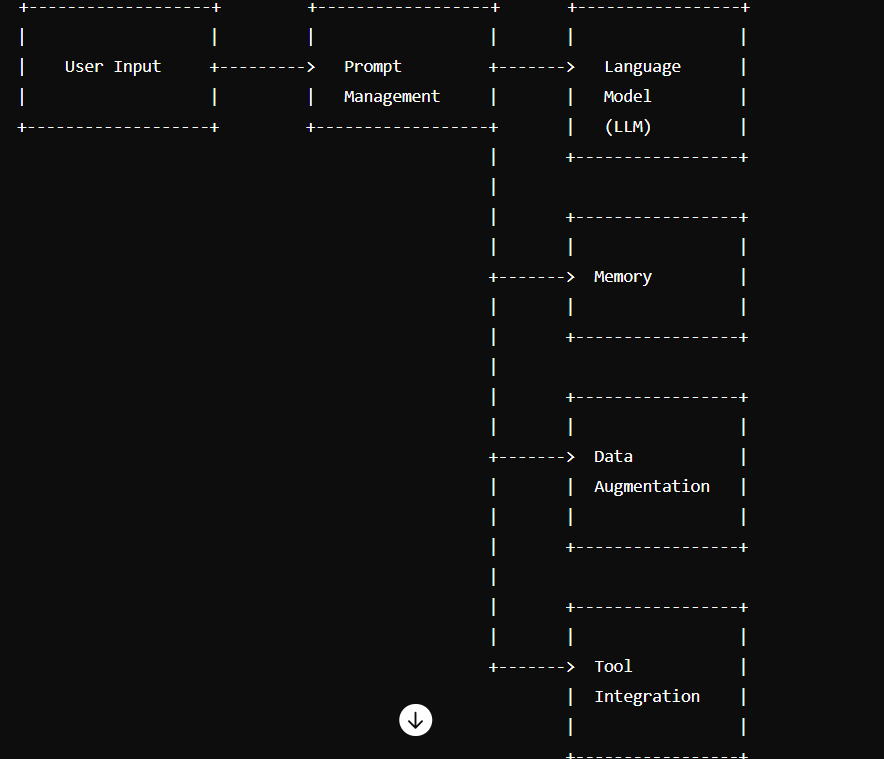
LangChain is a framework designed to simplify the development of applications using large language models (LLMs). It provides tools to connect LLMs with various data sources, manage different components of the workflow, and customize the interaction with these models. Here’s an explanation of LangChain with diagrams to illustrate its core concepts and components.

Core Concepts of LangChain

  1. Prompt Management:
  • LangChain allows developers to manage prompts effectively. This includes templating, formatting, and dynamically generating prompts based on the context.
  1. Chains:
  • Chains are sequences of operations or steps. A chain can be a simple sequence where a prompt is passed to an LLM and the response is processed, or it can be more complex with multiple steps involving different tools or models.
  1. Agents:
  • Agents in LangChain are components that can decide which action to take based on user input. They can dynamically select and run different chains or tools depending on the context.
  1. Memory:
  • LangChain provides mechanisms to maintain state or context across different interactions. This is useful for applications that require the model to remember previous interactions.
  1. Data Augmentation:
  • LangChain integrates with various data sources like databases, APIs, or custom data stores to provide contextually enriched responses.
  1. Tool Integration:
  • LangChain supports the integration of various tools and libraries to extend the functionality of LLMs, such as web scraping tools, search engines, or custom APIs.

Diagram: LangChain Architecture

Below is a simplified diagram illustrating the architecture of LangChain:
Detailed Components

1. Prompt Management

Prompt management involves creating and managing templates that are used to generate the actual prompts sent to the LLM. It includes static prompts, dynamic prompts, and context-based prompts.

+--------------------+
|  Prompt Template   |
+--------------------+
|  "What is the      |
|   capital of {X}?" |
+--------------------+
        |
        v
+--------------------+
|  Generated Prompt  |
+--------------------+
|  "What is the      |
|   capital of France?"|
+--------------------+

2. Chains

Chains define a sequence of operations where each step’s output serves as the next step’s input. They can involve multiple models, tools, or processes.

+---------+      +---------+      +---------+
|  Step 1 |----->|  Step 2 |----->|  Step 3 |
+---------+      +---------+      +---------+

3. Agents

Agents can dynamically choose which chain or tool to execute based on the input they receive.

+-----------+
|   Agent   |
+-----------+
      |
+-----v-----+
|  Decision |
|  Logic    |
+-----+-----+
      |
+-----v-----+
|   Chain   |
|  Selector |
+-----------+

4. Memory

Memory components help maintain context or state across different interactions with the user, allowing for more coherent and context-aware responses.

+-------------+
|  Interaction|
|  History    |
+-------------+
      |
+-----v-----+
|   Memory   |
|   Module   |
+-----------+

5. Data Augmentation

This component integrates external data sources to enrich the information provided by the LLM.

+---------------+
|  External     |
|  Data Source  |
+---------------+
      |
+-----v-----+
| Data      |
| Augmentation |
+-----------+

6. Tool Integration

LangChain can be extended with various tools that perform specific tasks like web scraping, database querying, etc.

+------------+
|   Tool 1   |
+------------+
|   Tool 2   |
+------------+
|   Tool 3   |
+------------+
      |
+-----v-----+
| Integration|
| Module     |
+-----------+

Example Workflow

Here is an example of how these components might work together in a LangChain application:

  1. User Input: The user asks a question.
  2. Prompt Management: The question is formatted using a prompt template.
  3. Chain: The formatted prompt is passed through a chain that might include a language model query, a database lookup, and a final synthesis step.
  4. Memory: The user’s question and the chain’s response are stored in memory for future context.
  5. Data Augmentation: If needed, the chain can pull in additional information from external sources.
  6. Tool Integration: Specific tasks within the chain might call external tools to fetch or process data.
  7. Response: The final, enriched response is returned to the user.

Conclusion

LangChain provides a structured framework for building sophisticated applications with large language models, integrating various tools, managing prompts, and maintaining context across interactions. This modular approach simplifies the development and scalability of LLM-based applications.
What’s the Diff between AI Platform and AI Framework?

Imagine you want to build a sandcastle. You need some sand, some water, and some tools. The sand is the data, the water is the computing power, and the tools are the algorithms.

A framework is like a set of instructions that tells you how to build your sandcastle. It provides the basic structure, but you still need to fill in the details. For example, a framework might tell you how to make a square base, but you need to decide how big you want the square to be and what kind of sand you want to use.

A platform is like a store that sells all the things you need to build a sandcastle. It has sand, water, tools, and even instructions. So, if you don’t know how to build a sandcastle, you can just go to the platform and buy everything you need.

In AI, a framework is a set of tools and libraries that help developers build AI applications. A platform is a more complete environment that provides everything developers need to build, deploy, and manage AI applications.

Here is a table that summarizes the key differences between frameworks and platforms in AI

FeatureFrameworkPlatform
PurposeProvides a set of tools and libraries for building AI applicationsProvides a complete environment for building, deploying, and managing AI applications
Level of abstractionLowHigh
Ease of useMore difficultEasier
FlexibilityMore flexibleLess flexible
CostTypically free or open-sourceCan be expensive

Whats happening in AI World?

Stanford’s AI index for 2021 has the following top takeaways

AI investment in drug design and discovery increased significantly:

“Drugs, Cancer, Molecular,Drug Discovery” received the greatest amount of private AI investment in 2020, with more than USD 13.8 billion, 4.5 times higher than 2019.

The industry shift continues:

In 2019, 65% of graduating North American PhDs in AI went into industry—up from 44.4% in 2010, highlighting the greater role industry has begun to play in AI development.

Generative everything:

AI systems can now compose text, audio, and images to a sufficiently high standard that humans have a hard time telling the difference between synthetic and non-synthetic outputs for some constrained applications of the technology.

AI has a diversity challenge:

In 2019, 45% new U.S. resident AI PhD graduates were white—by comparison, 2.4% were African American and 3.2% were Hispanic.

China overtakes the US in AI journal citations:

After surpassing the United States in the total number of journal publications several years ago, China now also leads in journal citations; however, the United States has consistently (and significantly) more AI conference papers (which are also more heavily cited) than China over the last decade.

The majority of the US AI PhD grads are from abroad—and they’re staying in the US:


The percentage of international students among new AI PhDs in North America continued to rise in
2019, to 64.3%—a 4.3% increase from 2018. Among foreign graduates, 81.8% stayed in the United States
and 8.6% have taken jobs outside the United States.

Surveillance technologies are fast, cheap, and increasingly ubiquitous:

The technologies necessary for large-scale surveillance are rapidly maturing, with techniques for image classification, face recognition, video analysis, and voice identification all seeing significant progress in 2020.

AI ethics lacks benchmarks and consensus:

Though a number of groups are producing a range of qualitative or normative outputs in the AI ethics domain, the field generally lacks benchmarks that can be used to measure or assess the relationship between broader societal discussions about technology development and the development of the technology itself. Furthermore, researchers and civil society view AI ethics as more important than industrial organizations.

AI has gained the attention of the U.S. Congress:

The 116th Congress is the most AI-focused congressional session in history with the number of mentions of AI in congressional record more than triple that of the 115th Congress

What is Machine Learning? Does a Machine Learn?

One of the most asked questions is How can a Machine Learn? Actually it can.

How does it learn? How do we teach a machine to learn? We give it examples.

We give many examples to the Machine.

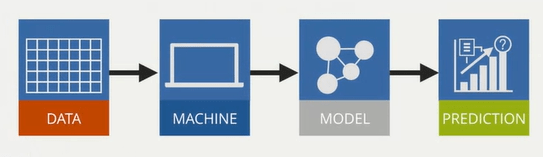
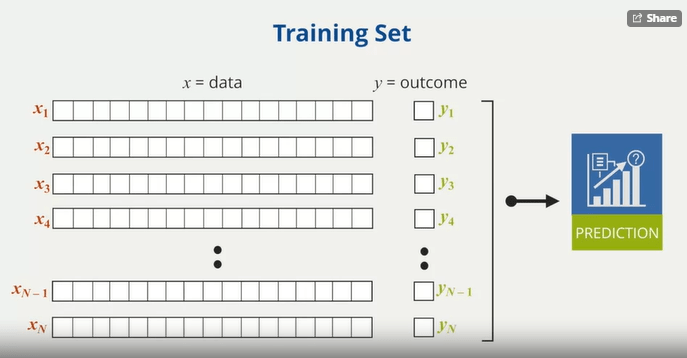
We take training data to teach a machine or an algorithm to do prediction accurately

E.g. we take a new data sample and the machine should Predict Y.

We take a Predictive model, which takes the Training Data which are historical data and produces the Output.

We create mathematical Model with Training set and then we give the model a new example which is not in training set and the model give the output y.

A model is characterized by a set of parameters and the Goal is to learn those parameters and after learning is done, we take new data and Predict the Outcome.

Amazing Popular Terms used in AI

  • CNN and ANN and RNN

CNN, ANN, and RNN are all types of neural networks used in machine learning and artificial intelligence, each with its own specific architecture and use cases:

  1. ANN (Artificial Neural Network):
    • An ANN is a computational model inspired by the way biological neural networks in the human brain process information. It consists of layers of interconnected nodes (neurons), where each connection has an associated weight. ANNs are used for a variety of tasks, including classification, regression, and pattern recognition. They are the foundational architecture for more specialized neural networks like CNNs and RNNs.
  2. CNN (Convolutional Neural Network):
    • CNNs are a type of neural network specifically designed for processing structured grid data, such as images. They use a mathematical operation called convolution to automatically and adaptively learn spatial hierarchies of features from input data. CNNs are particularly effective for image recognition and classification tasks due to their ability to capture spatial and temporal dependencies in an image through the use of filters and pooling layers.
  3. RNN (Recurrent Neural Network):
    • RNNs are designed to recognize patterns
  • Bias

In the context of machine learning and neural networks, “bias” can refer to a couple of different concepts:

  1. Bias in Neural Networks:
    • In neural networks, bias is a parameter that is added to the weighted sum of inputs to a neuron. It allows the activation function to be shifted to the left or right, which can be crucial for the model to learn the correct mapping from inputs to outputs. Bias terms help the model fit the data better by providing additional degrees of freedom. In mathematical terms, if a neuron computes a weighted sum of inputs as ( z = w_1x_1 + w_2x_2 + \ldots + w_nx_n ), the bias ( b ) modifies this to ( z = w_1x_1 + w_2x_2 + \ldots + w_nx_n + b ).
  2. Bias in Machine Learning Models:
    • Bias in this context refers to the error introduced by approximating a real-world problem, which may be complex, by a simplified model. This is part of the bias-variance tradeoff, a fundamental concept in machine learning. A model with high bias pays very little attention to the training data and oversimplifies the model, which can lead to under
  • Backward Propagation

Also known as back prop, this is the process of back tracking errors through the weights of the network after forward propagating inputs through the network. This is used by applying the chain rule in calculus.

Bounding Box

Cognitive Computing

Machine Learning

Deep Learning

corpus

Entity Annotation

Entity Extraction

Computer Vision

HyperParameter

Intent

Linguistic Annotation

Model

NLG and NLP and NLU

Overfitting

Parameter

Predictive Analysis

Supervised Learning and Unsupervised Learning and Reinforcement Learning

Semantic Annotation

Sentiment Analysis

General AI and Strong AI and Weak AI

Transfer Learning

Turing Test

GAN – Generative Adversarial Network

Heuristic

Perceptron: Single Neuron.

Logistic Regression or Sig-moid Function σ

A function used to activate the weights Network in Interval of 0,1; This function graph looks like a S which is told as Sigma in Greek. This is also known as Logistic Regression.

OpenAI is Open source : ?

OpenAI is not entirely open source. While OpenAI has released some of its models and code as open source, such as the original GPT (Generative Pre-trained Transformer) and certain versions of its reinforcement learning algorithms, many of its more advanced models, like GPT-3 and GPT-4, are not open source. These models are accessible through APIs, which allow developers to integrate them into applications, but the underlying code and model weights are not publicly available. OpenAI has taken this approach to balance the benefits of open research with concerns about safety, security, and misuse of powerful AI technologies.