

LangChain is a framework designed to simplify the development of applications using large language models (LLMs). It provides tools to connect LLMs with various data sources, manage different components of the workflow, and customize the interaction with these models. Here’s an explanation of LangChain with diagrams to illustrate its core concepts and components.
Core Concepts of LangChain
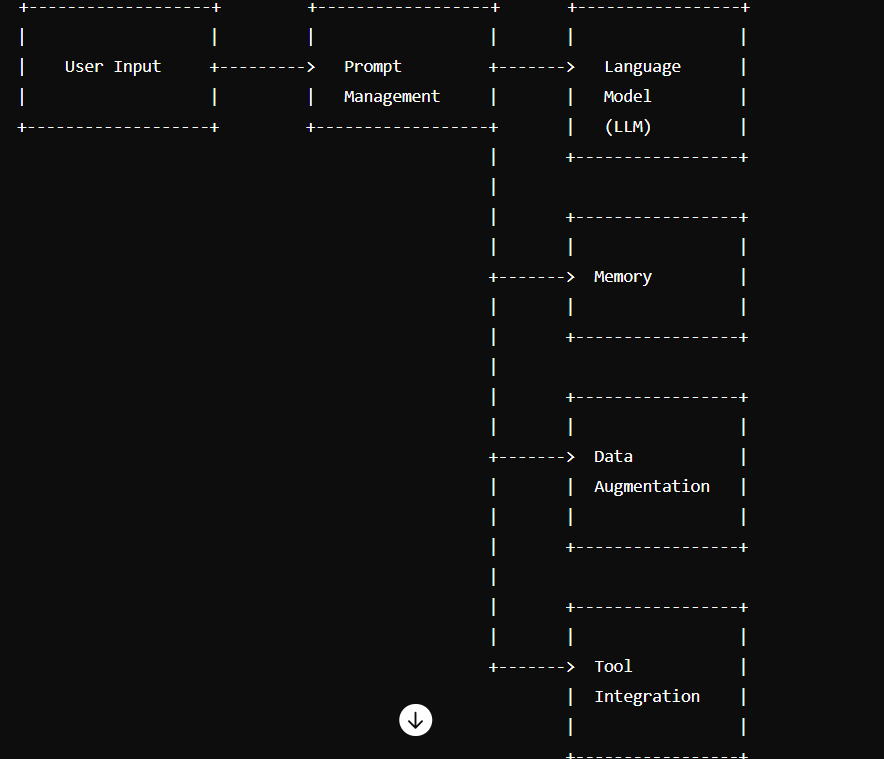
- Prompt Management:
- LangChain allows developers to manage prompts effectively. This includes templating, formatting, and dynamically generating prompts based on the context.
- Chains:
- Chains are sequences of operations or steps. A chain can be a simple sequence where a prompt is passed to an LLM and the response is processed, or it can be more complex with multiple steps involving different tools or models.
- Agents:
- Agents in LangChain are components that can decide which action to take based on user input. They can dynamically select and run different chains or tools depending on the context.
- Memory:
- LangChain provides mechanisms to maintain state or context across different interactions. This is useful for applications that require the model to remember previous interactions.
- Data Augmentation:
- LangChain integrates with various data sources like databases, APIs, or custom data stores to provide contextually enriched responses.
- Tool Integration:
- LangChain supports the integration of various tools and libraries to extend the functionality of LLMs, such as web scraping tools, search engines, or custom APIs.
Diagram: LangChain Architecture
Below is a simplified diagram illustrating the architecture of LangChain:
Detailed Components
1. Prompt Management
Prompt management involves creating and managing templates that are used to generate the actual prompts sent to the LLM. It includes static prompts, dynamic prompts, and context-based prompts.
+--------------------+
|  Prompt Template   |
+--------------------+
|  "What is the      |
|   capital of {X}?" |
+--------------------+
        |
        v
+--------------------+
|  Generated Prompt  |
+--------------------+
|  "What is the      |
|   capital of France?"|
+--------------------+
2. Chains
Chains define a sequence of operations where each step’s output serves as the next step’s input. They can involve multiple models, tools, or processes.
+---------+      +---------+      +---------+
|  Step 1 |----->|  Step 2 |----->|  Step 3 |
+---------+      +---------+      +---------+
3. Agents
Agents can dynamically choose which chain or tool to execute based on the input they receive.
+-----------+
|   Agent   |
+-----------+
      |
+-----v-----+
|  Decision |
|  Logic    |
+-----+-----+
      |
+-----v-----+
|   Chain   |
|  Selector |
+-----------+
4. Memory
Memory components help maintain context or state across different interactions with the user, allowing for more coherent and context-aware responses.
+-------------+
|  Interaction|
|  History    |
+-------------+
      |
+-----v-----+
|   Memory   |
|   Module   |
+-----------+
5. Data Augmentation
This component integrates external data sources to enrich the information provided by the LLM.
+---------------+
|  External     |
|  Data Source  |
+---------------+
      |
+-----v-----+
| Data      |
| Augmentation |
+-----------+
6. Tool Integration
LangChain can be extended with various tools that perform specific tasks like web scraping, database querying, etc.
+------------+
|   Tool 1   |
+------------+
|   Tool 2   |
+------------+
|   Tool 3   |
+------------+
      |
+-----v-----+
| Integration|
| Module     |
+-----------+
Example Workflow
Here is an example of how these components might work together in a LangChain application:
- User Input: The user asks a question.
- Prompt Management: The question is formatted using a prompt template.
- Chain: The formatted prompt is passed through a chain that might include a language model query, a database lookup, and a final synthesis step.
- Memory: The user’s question and the chain’s response are stored in memory for future context.
- Data Augmentation: If needed, the chain can pull in additional information from external sources.
- Tool Integration: Specific tasks within the chain might call external tools to fetch or process data.
- Response: The final, enriched response is returned to the user.
Conclusion
LangChain provides a structured framework for building sophisticated applications with large language models, integrating various tools, managing prompts, and maintaining context across interactions. This modular approach simplifies the development and scalability of LLM-based applications.

