
What is ML?
Arthur Samuel said it as: “the field of study that gives computers the ability to learn without being explicitly programmed.”
Tom Mitchell says with more detailed definition: “A computer program is said to learn from experience E with respect to some class of tasks T and performance measure P, if its performance at tasks in T, as measured by P, improves with experience E.”
In general, any ML problem can be assigned to one of two broad classifications:
supervised learning, OR
unsupervised learning.
Supervised Learning
In supervised learning, we are given a data set and already know what our correct output should look like, Knowing relationship between the input and the output.
Supervised learning problems are categorized into “regression” and “classification” problems.
In a regression problem, we are trying to predict results within a continuous output,
In a classification problem, we are instead trying to predict A or B
Unsupervised Learning
Unsupervised learning, on the other hand, allows us to approach problems with little or no idea what our results should look like.
With unsupervised learning there is no feedback based on the prediction results, i.e., there is no teacher to correct you.
Eg:
Clustering: Take a collection of 1000 essays written on the US Economy, and find a way to automatically group these essays into a small number that are somehow similar or related by different variables, such as word frequency, sentence length, page count, and so on.
Non-clustering: The “Cocktail Party Algorithm”, which can find structure in messy data (such as the identification of individual voices and music from a mesh of sounds at a cocktail party .
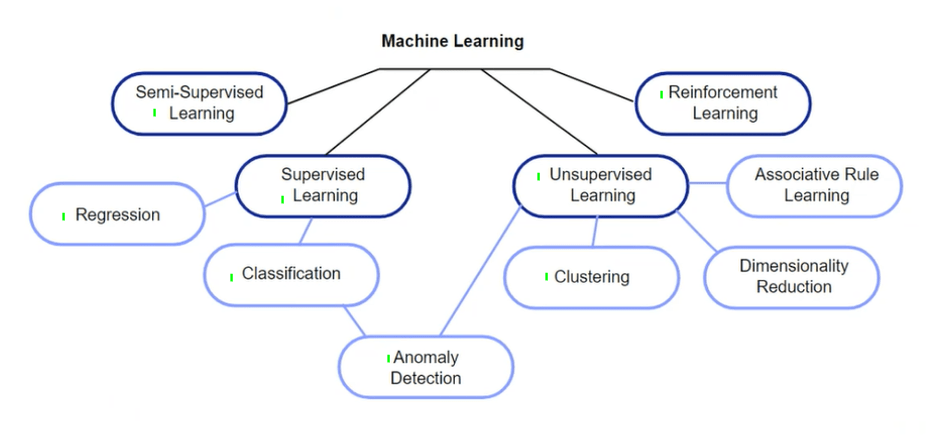
How much or How many – Regression
Is this A or B – Classification
Is this weird – Anomaly detection
How is it organized? – Clustering
What should I do next? – Reinforcement Learning

